
Consort Instruments
 Models
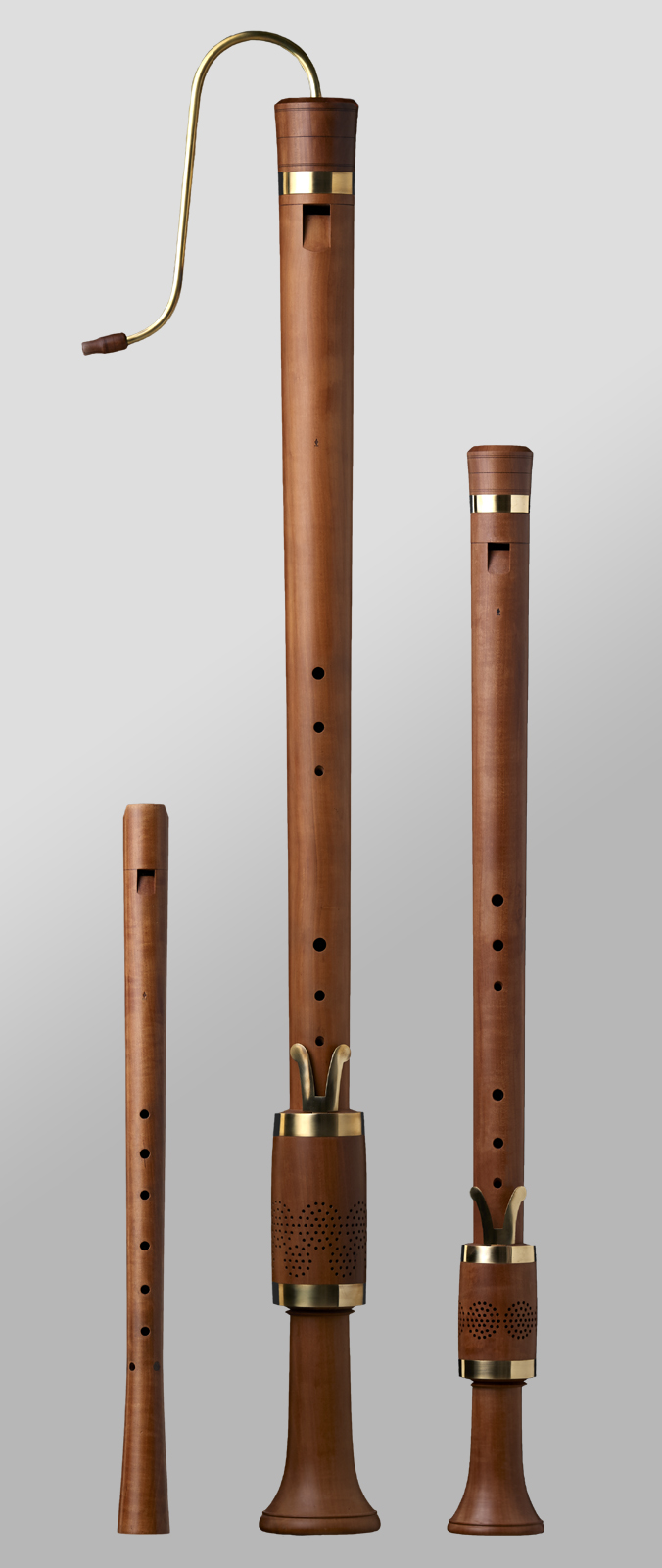
Original instruments in various European museums have provided the models for my Renaissance recorders, which retain all the essential features of their originals, with no attempt at modern ‘improvements’. Thus my recorders have a slightly conical bore, curved windway and edge, undercut finger holes and a ‘plain’ exterior; the larger ones are fitted with a swallow-tail key and fontanelle. Since the models originated with various makers and often have divergent pitches, it has, however, been necessary to make slight adjustments to individual prototypes in order to integrate the recorders into an overall musical whole with regard to tuning as well as tonal quality. None of these adjustments exceeds the boundaries set by preserved original Renaissance recorders considered collectively.
Finger holes

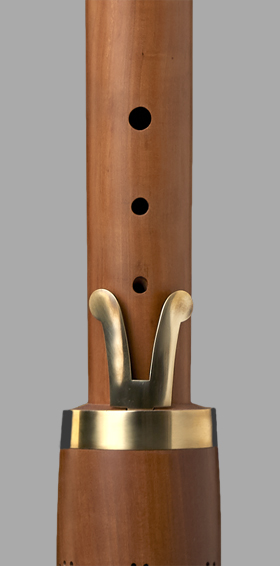 are placed as on the original instruments, the upper six in front in a straight line; the seventh is drilled in two places, right and left of centre, for the convenience of either right or left little finger, depending on which hand the player uses lowest. The hole which is not used (most often the left one today) is stopped with wax. On the larger recorders the seventh hole is covered by the key, which is similarly symmetrical in form and can thus be reached by either hand. The spacing and size of finger holes can cause problems for players with small hands. In special cases, placement of finger holes can be modified if so desired.
Fingering
The recorders are normally made with original Renaissance fingering, in which the ninth note of the recorder is taken with all holes open. The smaller models can, however, be ordered with the fingering for the ninth note which is usual for Baroque and modern recorders (i.e. middle finger of the upper hand).
Division
Normally the recorders (like the originals) are built in one piece, but the bigger sizes can be ordered built in two pieces, divided between mouthpiece and finger holes. On the octave bass in F, however, the foot with key and fontanelle is always separate.
The naming of the different sizes of recorders
The naming of recorder sizes has varied over time and across regions and is still not standardized, neither among musicians, scholars, nor instrument makers. The first source from the Renaissance that names recorder sizes is Sebastian Virdung in 1511. It is noted there that the ‘standard’ quartet of the time consisted of a Bassus in f, a Tenor in c’, an Altus (likewise) in c’, and a Discantus in g’. The two middle voices in a four-part piece were thus played by recorders of the same size, and Tenor and Altus appear more to indicate which part they were to play in the polyphonic composition than to denote their size or pitch. This perspective is echoed by Praetorius in 1619, where the number of different pitches is expanded both upwards and downwards compared to the standard quartet. In his table of ranges, for example, he does not assign any specific name to the (tenor) recorder in c’, but notes that in different contexts it can function as Bassus, Tenor, Altus, or Cantus.
In the absence of clear historical designations for the sizes, I have chosen to use Virdung as a starting point and, for example, called the recorder in f a bass, the recorder in c’ a tenor, and the recorder in g’ a treble. For the bigger recorders in c and Bb, I have chosen—following, for instance, Praetorius’ designations for the lower dulcians—respectively quart bass and quint bass. For the higher models, which lack historical names, I have opted for modern terms such as alto, soprano, and sopranino.
Combination of recorders in sets
Renaissance recorders are ideal for ensemble playing, as they give the greatest clarity to each voice of the composition, while at the same time blending tonally. As mentioned above, the most usual quartet in the High Renaissance (ca. 1550) consisted of a treble in g’, two tenors in c’ and a bass in f. Most of the surviving four-part music can be played by this combination, and sounds in 4’ pitch, an octave above the written pitch. For mellower tone, one might choose to play the same pieces on a transposing quartet consisting of tenor in c’, two basses in f and a quint bass in Bb; or the low quartet (sounding at written or 8’ pitch) consisting of basset in g, two quart basses in c and octave bass in F. If one concentrates on music from the last part of the Renaissance (towards the end of the 16th century) at 4’ pitch, it can be advantageous to supplement the standard quartet with a soprano in c” and an alto in f’; these are also useful in many pieces from the earlier period selected for modern publications.
Voicing
The majority of the music played on recorders during the Renaissance was vocal music, primarily written for singers, but, following the practice of the time, could also be performed instrumentally. In voicing my recorders, I have aimed to give them a singing quality: a tone and articulation that, when combined in a consort, evoke as faithfully as possible the harmony and balance of a well-balanced vocal ensemble. In line with this, the higher recorders in the ensemble are built so as not to be shrill or dominating in sound in comparison with the lower ones.
Pitch and tuning
 The pitches of original Renaissance recorders range between ca. 430 and 470 Hz. My recorders are built either at a’ = 440 Hz or a’ = 466 Hz (nominally). Most models are tuned to a’ = 440 Hz, corresponding to the most widely used modern pitch standard, but to accommodate ensembles that play at the higher pitch, I also offer the standard Renaissance sizes (bass in f, tenor in c’, and treble in g’) tuned to 466 Hz.
Regardless of pitch level, all recorders are tuned in meantone temperament, in which the major thirds are perfectly pure. In addition to being historically correct, this temperament makes it considerably easier to tune perfectly pure chords. In meantone temperament, the note A is relatively low, which is why C has instead been chosen as the reference pitch. In practice, this means that a’ lies at 437.4 Hz and 463.2 Hz respectively (see diagram). If the customer, however, prefers A as the reference pitch instead of C, this can be arranged as a custom order. In that case, a’ is tuned exactly to 440 or 466 Hz, and in return, tones such as F, C, and Bb will be higher than in the corresponding equal temperament.
Details of types in 440 Hz
| Type | Prototype location | Range | Specifications |
|---|---|---|---|
| Sopranino in g" | (my own) | g"-e"" | |
| Soprano in d" | Vienna SAM 131 | d"-c"" | |
| Soprano in c" | Vienna SAM 131 | c"-b''' | |
| Treble in g' | Frankfurt/Main x/4265 | g'-f''' | |
| Alto in f' | Frankfurt/Main x/4265 | f'-eb''' | |
| Tenor in c' | Brussels 1024 | c'-bb" | narrower option |
| Tenor in c' | Vienna SAM 150 | c'-bb" | wider option |
| Basset in g | Brussels 2646 | g-f" | blown directly, one key |
| Bass in f | Brussels 1031 | f-d" | rim blown (cap with hole), one key |
| Quart bass in c | Brussels 188 | c-a' | cap with crook, one key |
| Quint bass in Bb | Verona 13245 | Bb-g' | cap with crook, one key |
| Octave bass in F | Paris E2141 | F-d' | cap with crook, one key |
Details of types in 466 Hz
| Type | Prototype location | Range | Specifications |
|---|---|---|---|
| Treble in g' | Frankfurt/Main x/4265 | g'-f''' | |
| Tenor in c' | Vienna SAM 150 | c'-bb" | |
| Bass in f | Brussels 4358 | f-d'' | rim blown (cap with hole), one key |
Materials and finish
The recorders are made in pearwood or stained sycamore maple, with brass rings at joints and on the fontanelle. The surface is treated with linseed oil. Made exclusively according to traditional craftsmanship, each instrument is subject to the greatest care, and is played a long time during voicing and tuning to make its tone as stable as possible. This does not, unfortunately, prevent the wood from ‘settling’ later; it is therefore advisable occasionally to send the recorder to my workshop for readjustment.
Sound and video samples can be found here.